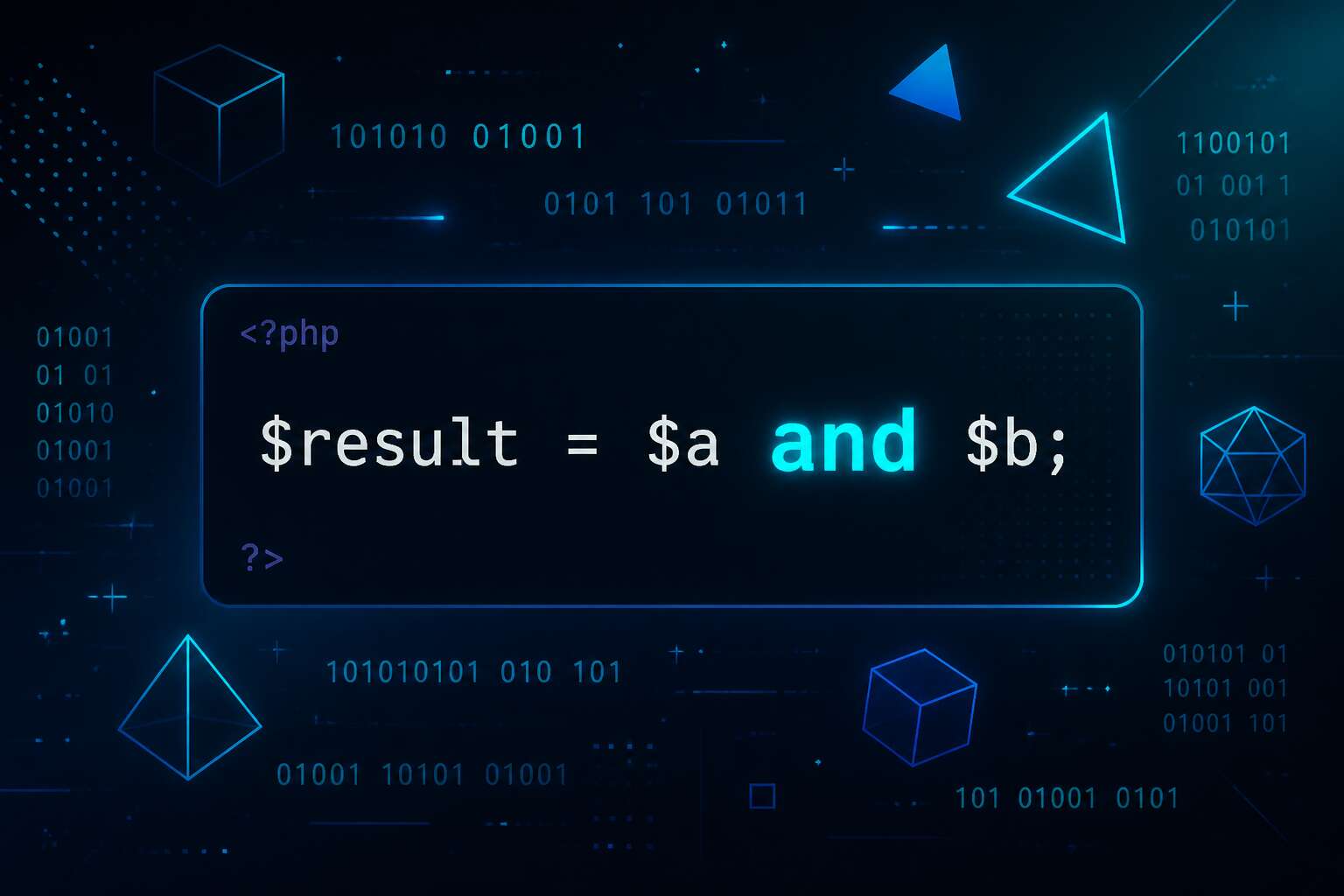
The Role of Logical Operators in PHP
Comparing Logical Operators: AND, OR, NOT
In the digital economy, where a fraction of a second can determine a user’s trust, the `php and operator` is the silent architect of dynamic decisions. It is the elegant logic that transforms a static page into a responsive conversation, a digital handshake between the server and the visitor. By wielding these operators effectively, you are not just writing code; you are crafting the very conditions of possibility for your web application, ensuring that every path taken is one you have anticipated.
The core of this control lies in the syntax of PHP, where we blend boolean values to create a singular outcome. The AND operator is the purist, demanding total agreement from all its operands. It is the meticulous gatekeeper, ensuring that every single condition is met before proceeding. Imagine building a secure portal where a user must verify their identity and their location. The logic must be absolute, leaving no room for error. Conversely, the OR operator is the realist, offering multiple avenues to success. It acknowledges that life is rarely binary, accepting that a user might arrive via a mobile app or a desktop browser, granting access if any single condition is true.
To truly grasp the nuance, consider how these operators evaluate their arguments. The behavior is not merely mathematical, but sequential.
- The AND operator returns true only if both the left and right conditions are true.
- The OR operator returns true if either the left or right condition is true.
- The NOT operator, a singular force, simply inverts the truth value of a single expression.
The NOT operator is the quiet contrarian, the one who looks at a statement and asks, “What if this is false?” It is essential for actions like checking if a user is logged out or if a file does not exist, allowing you to handle exceptions gracefully. When you combine the strictness of AND with the flexibility of OR, and the inversion of NOT, you build a decision matrix that can handle the complexity of the real world. This is how you create a system that feels intuitive, not rigid, a landscape where the code understands the user’s intent without demanding a single, prescribed path.
Mastering this subtle grammar is about more than syntax. It is about understanding the flow of control and the philosophy of your application’s behavior. The precision of the `php and operator` gives you the power to define your own rules of engagement, to say “yes” or “no” with absolute certainty)Skip the ambiguity. This is where the technical meets the poetic, in the exact moment a condition is met and a new experience is rendered.
Why the AND Operator Matters in Conditional Logic
In PHP, logical operators decide which branches of your application ever run. The `php and operator` is the strictest of these: every operand must be true, and if the left side fails, the right side is never evaluated. That short-circuit behavior saves processing time and prevents errors from accessing values that are not present.
Why does AND matter in conditional logic? Because it protects dependent operations. You check that a user is authenticated before checking their role. You verify that a file exists before reading its contents. Each step depends on the previous one, and the operator refuses to skip ahead.
- It enforces order in multi-step validations.
- It lowers the chance of exceptions when the right side is risky.
In layered access checks, this strictness stops a small failure from cascading into a larger one.
Operator Precedence and Associativity
JavaScript developers migrating to PHP often assume all logical operators behave identically. The truth is more unsettling. Consider that the `php and operator` has a lower precedence than the assignment operator (`=`) and even the `or` operator. This hidden hierarchy frequently causes logic that parses correctly but executes in an unexpected order)Skip; the error is silent until production.
Precedence dictates the sequence of evaluation, but associativity defines the direction. For logical operators like `and`, the evaluation is left to right. However, this is where human intuition clashes with machine order. When you type `$result = true and false;`, the assignment happens first, and the `and` operation occurs afterward. The value stored in `$result` is the first operand’s value, not the overall result. This distinction is a pitfall for developers who write conditionals that appear straightforward.
The implication is psychological as much as technical. We read code and see a chain of dependencies. The machine sees a strict hierarchy. Using `&&` instead of `and` often resolves the confusion because `&&` has a higher precedence. Yet the lower precedence of the `php and operator` is not a flaw; it is a tool for writing readable expressions where the assignment is the primary actionable functionhots lead to subtle bugs in validation logic. When you check permissions or user input, relying on `and` in a complex expression can create gaps in the checks. The right side might not evaluate at all if the precedence causes the left side to bind differently than expected. This is why understanding associativity matters; it determines whether the condition `$a and $b and $c` evaluates as `(($a and $b) and $c)` which is logical. The failures occur when mixing `and` with other operators in the same statement, distorting the expected sequence of checks.
Deep Dive into the AND Operator
Syntax and Basic Usage of `and`
In the quiet hours of the morning, when the farmhands are checking the weather and the condition of the fences, a decision often hangs on multiple factors. The `and` operator in PHP works in a similar way, allowing you to test several conditions before a block of code springs into action. Its syntax is straightforward. You write your first condition, then `and`, then your second condition. If both are true, the whole expression is true. For example, `if ($soilMoisture > 20 and $sunlightHours > 6)`.
Using `and` in code often mimics the way we naturally speak about dependencies. The operator tells the interpreter to evaluate the left side first. If that is false, the right side is never checked. This is a type of short-circuiting, but it feels like a farm manager saving effort by not checking the water troughs if the barn door is already locked. This practical behaviour keeps scripts running efficiently.
The basic usage extends beyond `if` statements. You can use it to govern a loop or to assign a value based on a prior successful operation. Consider this sequence.
- A user submits a form.
- The script validates the email address.
- The script checks the password length.
- Only if both are correct does the `and` expression return true.
A clear example is `$login_ok = $user_found and $password_matches;`. The emphasis on readability is a genuine asset here. When you read the code back, the word `and` feels conversational. It serves as a bridge between two necessary truths, ensuring that the php and operator remains a clear way to structure your logic without wrestling with punctuation or symbols.
Difference Between `and` and `&&`
The difference between `and` and `&&` in PHP is not cosmetic. They share the same logical meaning, but they carry different precedence levels. The `&&` operator binds tighter than `and`, meaning expressions with `&&` are evaluated earlier in the order of operations. This is where the php and operator shows its quieter nature.
“`php
$result = true and false;
“`
The assignment completes first, so `$result` becomes `true`. With `&&`, the expression evaluates to `false`. The php and operator sits lower in precedence, allowing the assignment to finish before the logical test. `&&` demands attention first.

- `&&` has higher precedence than `=`.
- `and` has lower precedence than `=`.
This single difference can produce distinct outcomes. For those who write PHP in the dark hours of debugging, knowing which operator answers first is essential.
Return Values and Type Juggling
The php and operator returns a boolean, but type juggling decides what counts as truth. The string `”false”` remains true, while the integer zero and the empty string collapse into false. A variable holding `”0″` is falsy, a quirk that surprises many. Each operand converts to a boolean before the operator acts. This conversion is silent. No errors appear. The result is true or false, depending on the coerced meanings.
Common falsy values include:
- `0` and `0.0`
- `”0″`
- `null`
- `false`
- an empty array
Everything else leans toward true. So `1 and “one”` returns true, while `1 and “0”` returns false. Understanding this saves you from hidden logic failures.
Short-Circuit Evaluation Explained
Short-circuit evaluation is where the php and operator shows its efficiency. When PHP evaluates `$result and do_something()`, it checks the left operand first. If that operand is falsy, PHP never touches the right side. The function never runs. The side effects never happen. I rely on this behaviour, and it is deliberate.
Consider a file check: `file_exists($path) and include($path);`. The include only executes when the file exists. No warning, no wasted work. The alternative with an if statement works too, but the short-circuit version keeps the logic in one line.
Here is what short-circuiting prevents:
- Unnecessary function calls
- Fatal errors from missing variables
- Expensive database queries that would return nothing
The php and operator does not evaluate what it does not need. That saves time, and that matters!
Practical Applications of the AND Operator
Validating User Input with Multiple Conditions
Picture this: the digital storefront of your Johannesburg-based business is buzzing. A customer in Cape Town is trying to check out, but a faulty form field is blocking their path. That friction costs you a sale. This is where the php and operator become your silent sentinels, guarding the gates of your user experience.
When a user submits their details, you rarely check just one thing. You need to verify that a field is not empty, that the email format is correct, and that the password meets your length requirements. Instead of nesting these validations into a confusing pyramid of `if` statements, you can use a single condition. The elegant `and` operator allows you to group these checks, ensuring the execution only proceeds when every criterion is met.
Consider a standard login scenario. You want to query the database only if a username exists, and the account is active. Using the `and` operator in conjunction with `isset()` prevents unnecessary errors and resource drain.
“`php
“`
This approach streamlines your logic, but it also introduces a layer of security efficiency. The short-circuit nature means that if the first condition returns `false`, PHP immediately stops evaluating the expression. It won’t even look at the second condition. This is particularly useful when the second condition is a database lookup or a function call that involves overhead. You save processing power by skipping the expensive operation entirely.
Here is how this principle enhances your security protocols:
- Prevent SQL injection by checking for a valid user ID before building a query.
- Stop unauthorized access by verifying a session token and a user role simultaneously.
- Reduce server load by confirming a file exists before attempting to read it.
- Ensure data integrity by checking for a numeric value and a positive range before entering a financial transaction.
This precise control over the evaluation process turns the php and operator from a simple logic gate into a tool for writing leaner, faster code. It reflects a deeper understanding of how PHP parses expressions, allowing you to write conditions that are not only readable but also optimized for performance. In the competitive landscape of web development, these micro-optimizations contribute to a more responsive site for your users, keeping them engaged and moving them further down your sales funnel without the frustration of broken interactions.
Using AND in Database Query Filters
Database queries often hinge on the alignment of multiple conditions. The php and operator is the tool for this job when you need to enforce a strict set of criteria before a record is pulled or changed. For instance, consider a content management system where a user can edit a post only if they are the author and the post is in a draft state. A single query using `WHERE author_id = ? AND status = ‘draft’` prevents any accidental edits to published content.
You might think a simple `if` statement covering one variable at a time would work, but that approach creates cluttered code and opens a window for logical errors. Using `&&` inside a `while` loop or a conditional statement keeps the logic transparent. Your code clearly states that both the user ID and the status flag must match for the action to proceed. This reduces the risk of updating the wrong rows, a mistake that can be costly when dealing with user permissions or inventory levels.
Beyond simple equality checks, you can also verify time-sensitive data with the php and operator. Here are a few practical scenarios where this shines:
- Displaying a promotion only if the current date is after the start date and before the end date.
- Allowing a login attempt only if the account is active and the password reset token is still valid.
- Filtering product searches where the item is in stock and matches the selected category.
These examples show how the php and operator is not just a syntax feature; it is a gatekeeper for your data’s integrity. By combining conditions in your database query filters, you ensure that every result set meets the full spectrum of your business rules, without needing multiple, separate validation steps in your PHP code.
Combining AND with Loops and Arrays
A single misplaced condition in a loop can silently corrupt an entire dataset. In the South African e-commerce sector, order processing errors often stem from validation logic that checks each field in isolation. This is where the php and operator transforms a routine loop into a rigorous gatekeeper.
When you iterate through an array of products, consider applying the php and operator to enforce multiple rules within each cycle. For instance, when syncing inventory from a supplier feed, you might need to update a product only when the supplier ID matches and the stock level has changed. Embedding this combined check inside a `foreach` loop prevents unnecessary writes to your database.
“`php
foreach ($inventory as $item) {
if ($supplierId == $item[‘supplier’] and $item[‘stock’] != $storedStock[$item[‘sku’]]) {
// update record
}
}
“`
This logical pairing also simplifies user session management. A dashboard can display sensitive data only when the user role is administrator and the account status is verified. You can scan a multi-dimensional array of user permissions, applying the php and operator to confirm both flags before granting access to a report.
The utility extends to form processing. When handling an array of submitted inputs, you can validate that a field is not empty and that it passes a format check before storing it. This approach keeps your logic linear and reduces the need for nested conditionals.
When you need to manage a list of rules for a subscription tier, the operator helps identify which features apply:
- Check if the user is on a premium plan and the feature is marked as exclusive.
- Verify if the payment cycle is annual and the renewal date is within the next 30 days.
- Confirm if the user has opted into notifications and the channel is active.
This combined validation inside loops ensures that every element in your array is vetted against the full set of business rules. It reduces the chance of partial updates and keeps the readability of your code high, especially when the logic scales across large datasets.
Complex Business Logic with Nested Conditions
Real business rules have layers, and in South African retail, an order is not approved because one flag passes. It is approved when payment clears, stock exists, and credit limits align. Nesting these checks with the php and operator mirrors how decisions are made in practice.
I see the difference most clearly in approval chains. A human approver would not grant a premium override based on a single attribute. They would examine the customer tier, the order value, and the shipping destination. In PHP, that entire reasoning fits inside one conditional. The php and operator binds each criterion to the next, so a failure anywhere halts the process. This efficiency matters when risk functions sit inside larger workflows.
Consider the layered checks in a typical approval chain:
- Verify the order origin is domestic.
- Confirm the customer’s payment history contains no disputes.
- Ensure the requested credit extension remains under the monthly threshold.
Each nested condition narrows the path forward until only valid transactions remain.
Handling Form Submissions with Security Checks
Every web form in South Africa opens a door. A login page, a contact form, a payment gateway. Each one invites scrutiny. I use the php and operator to check the submitted token, the session state, and the request origin before a single line of business logic runs.
Consider a typical staff portal submission. The system must confirm three things before trusting the payload:

- The CSRF token matches the stored session value.
- The user role permits the action.
- The form payload passes basic type validation.
This single operator holds all three conditions in one guard clause. If any check fails, the submission stops immediately. That is how one line of PHP protects an entire form from unwanted access.
Common Mistakes and How to Avoid Them
Precedence Pitfalls in Mixed Expressions
PHP’s “and” operator has a precedence lower than assignment, which creates a trap in mixed expressions. You write `$status = $valid and $allowed;` and expect a boolean, but PHP assigns `$valid` first, then evaluates `and $allowed` separately. The result? Your variable stores the wrong value while the expression quietly proceeds.

Common mistakes in mixed expressions include combining `and` with `&&` without parentheses, relying on implicit precedence, and nesting `and` inside ternaries. Each leads to unpredictable behavior.
- Using `and` in an assignment without explicit parentheses
- Mixing `and` with `or` in the same condition
- Assuming `and` behaves identically to `&&` in every context
Precedence pitfalls disappear when you force clarity with `( )` around every logical grouping. The syntax becomes verbose, but correctness wins. Remember that the php and operator has a specific role, and treating it like `&&` invites bugs.
Misunderstanding Short-Circuit Evaluation
One silent failure emerges when developers rely on the php and operator inside a Boolean context that expects a swift exit. Short-circuit evaluation means the right operand may never execute. That behavior is often misunderstood when the left side returns false.
Consider a login guard that checks a session token before querying the database. If the first condition fails, the second expression, which might contain a cleanup routine or a log write, is ignored entirely.
- The php and operator skips the second operand when the first is false.
- `&&` behaves identically in this regard.
- The misconception is that `and` might always evaluate both sides.
This leads to functions that silently skip essential steps. A common scenario is a validation chain where a fallback value must be assigned, but the assignment never happens. The final verdict can be a variable holding an unintended state, all because the evaluation path chose the shorter route.
Type Issues When Using `and` vs `&&`
Type juggling in PHP often trips developers when mixing `and` with comparison operators. The php and operator has lower precedence than `=`, so `$result = true and false` assigns `true` to `$result`, not `false`. That subtle behaviour produces unexpected variable states, particularly in validation logic where a boolean must be exact.
Another issue arises when using `and` in function returns. A typical mistake is `return $check and $value;` which evaluates the assignment first. The result becomes `$check`, ignoring the right side entirely. Meanwhile, `&&` respects normal precedence, giving the intended combined result.
- `$flag = $a and $b` assigns `$a` to `$flag`, then runs `and $b` separately.
- `$flag = $a && $b` correctly assigns the logical AND of both operands.
- `if ($a and $b)` works fine, but mixing with assignment changes the outcome.
To avoid these traps, always wrap expressions in parentheses when using `and` in assignments. Check your conditional chains for implicit type conversions that might flip expected booleans. Testing with strict equality helps surface such issues early.
Performance Considerations and Best Practices
When to Use `and` vs `&&` for Readability
Performance differences between `and` and `&&` in PHP are essentially negligible. Micro-optimizations here won’t save your server. What actually matters is operator precedence and how it affects your code’s logic. Because `&&` sits higher in the precedence chain, it binds tighter than `=`, making it the safer choice for complex conditional statements where you need strict evaluation order.
However, the `php and operator` shines in specific readability scenarios, particularly when you want a statement to read like plain English. For example, `redirect($url) or die(‘Error’);` flows naturally. But for general use, prioritize clarity: reserve `and` for side-effect-driven statements and `&&` for pure comparisons. A consistent approach prevents subtle bugs and keeps your team’s codebase intuitive to navigate.
Optimizing Conditions for Fast Execution
“Premature optimization is the root of all evil,” said Donald Knuth, and if you’re swapping `&&` for `and` in a desperate bid for speed, you might be the villain in that story. The `php and operator` performs exactly one job: joining conditions. It doesn’t bring a performance penalty, and it certainly doesn’t offer a reward. The interpreter compiles both forms down to similar opcodes, so your server’s precious milliseconds are spent elsewhere, likely on a database query gone rogue.
Performance considerations for `php and operator` are a red herring. What truly impacts execution time is the condition itself, not the glue holding it together.
- Swapping operators for “speed” yields zero gains.
- Ordering expensive function calls after cheap comparisons is a real win.
- Relying on short-circuit evaluation to skip heavy computations is the actual optimization.
- Using `php and operator` to obfuscate logic only guarantees slower debugging.
The best practices for optimizing conditions are straightforward: compute the cheap stuff first. If you have an `isset()` check and a `preg_match()`, let the `isset()` take the lead. Short-circuit evaluation ensures that if the first condition fails, the second never runs. That is a tangible benefit. The `php and operator` follows the same rules as `&&` here. Focus on the logic that precedes it. Readable code with clear conditions is faster to ship, faster to profile, and faster for your future self to understand at 2 AM.
Shipping Clean Code Style Guides with AND
Some developers treat the `php and operator` as if it were a performance liability. That reputation is undeserved. Modern PHP engines compile `and` to the same underlying opcodes as `&&`, meaning the execution cost is identical. Your bottleneck is never the operator itself, it is the conditions you ask it to evaluate. A sluggish query or a recursive function will end your request long before the interpreter notices which logical operator you chose.
Clean code style guides often mandate consistency over cleverness. If your team standardizes on `and`, use it everywhere a low precedence join is needed. This approach clarifies intent, especially when mixing assignments with conditionals. Consider these practices for shipping readable logic:
- Place the most likely failing condition first to leverage short-circuit evaluation.
- Name intermediary variables to avoid stacking multiple `and` joins.
- Use parentheses liberally to make precedence explicit, even when not strictly required.
Readable code becomes maintainable code. A team in Johannesburg or Cape Town can audit a pull request faster when the logical flow is obvious. The `php and operator` gives you that clarity, provided you use it with discipline. Consistency reduces cognitive load and prevents the subtle bugs that emerge when someone mistakes precedence for purpose.
Testing and Debugging Logical AND Conditions
Performance considerations for the php and operator rarely justify micro-optimization. Profile your code first to see where time actually accumulates. Most slowdowns live inside database queries or external API calls, not in the logical join itself. When a condition triggers expensive code, short-circuit evaluation means operand order matters more than the operator name.
Testing the php and operator in logical AND conditions demands deliberate coverage of every branch. A unit test should verify the true path and the false path independently. When debugging, isolate each condition with logging to expose which side fails. Use assertions to confirm intermediary variables hold expected values.
- Check precedence when mixing `and` with assignment expressions.
- Trace short-circuit behavior by temporarily forcing each operand true or false.